The Recruitment Market Flipped: Why Winning Clients Became Harder Than Finding Candidates

For a decade the constraint was talent. Now it’s demand — and every tool the industry bought was built for the old problem. What the data shows, why it happened, and what it changes for how agencies sell.
Quick answer
Something fundamental changed in the recruitment industry, and most agencies are still operating as though it didn’t. For most of the post-pandemic period, agencies competed on the candidate side: sourcing was hard, and an agency that could reliably deliver talent had willing clients. The constraint was supply.
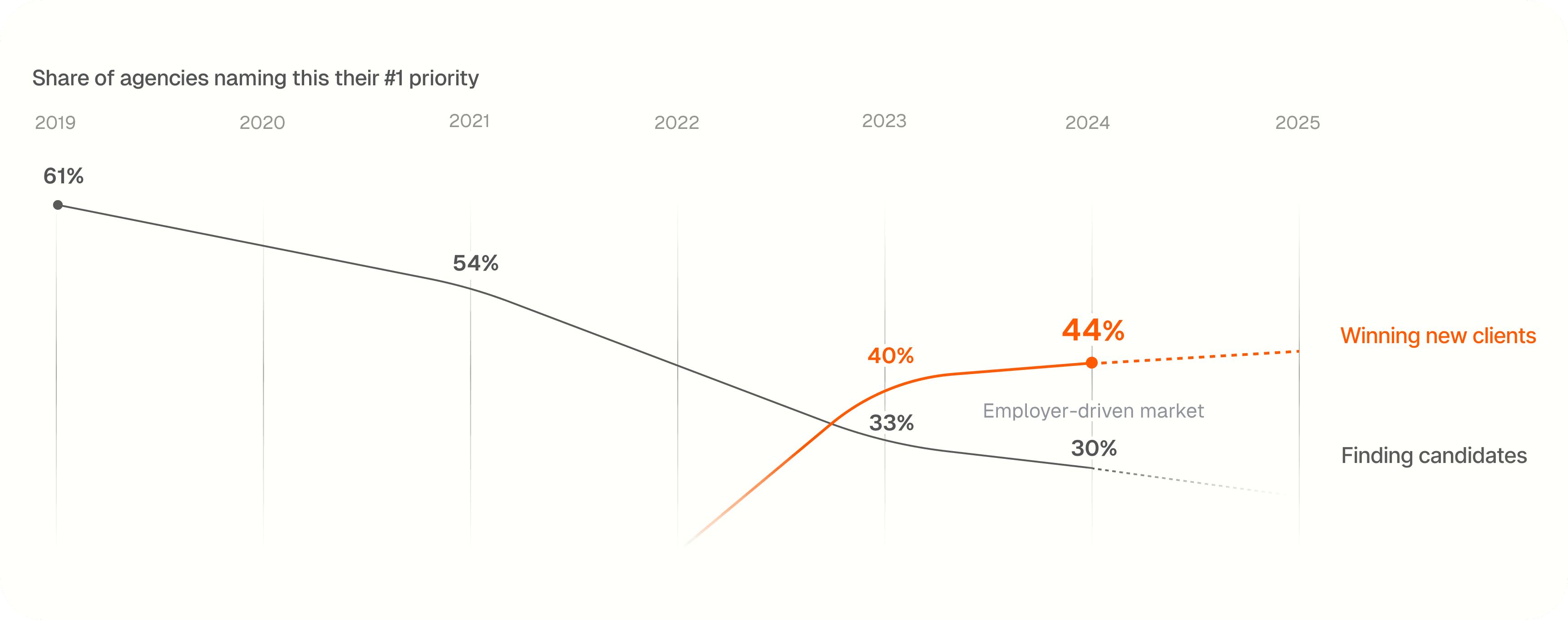
The constraint is now on the demand side. Winning new business has been the number-one priority for staffing firms three years running in Bullhorn’s GRID industry survey — first cited by 44% of firms, against 30% naming candidate acquisition. Meanwhile 65%+ of staffing firms now name client acquisition as their single biggest obstacle. The US staffing market contracted to $113.5 billion in 2025, down 8.5% year over year, which means more agencies chasing a smaller pool of briefs.
Three consequences follow, and together they explain why BD stopped working the way it used to:
Buyers got harder to reach. Client ghosting — once a candidate problem — migrated into business development. Decision cycles lengthened, procurement got more involved, and the people agencies used to reach directly became guarded. BD activity is up; conversion is down.
The software doesn’t fit. Recruitment technology was built for the old bottleneck. There are hundreds of tools for finding candidates and almost none for finding clients — so the hardest job in the agency is the one with the least tooling.
A performance gap opened. Agencies using AI across the recruitment cycle are 3.5-4.5x more likely to have grown revenue — a gap that widened from a 25-40% advantage just a year earlier. The firms pulling ahead aren’t working harder; they’re systematically reaching clients earlier.
This guide covers what the data actually shows, the forces behind the flip, why the old BD playbook stopped converting, and what the agencies growing in this market do differently.
The numbers that matter
Winning new clients has been the #1 priority for staffing firms three years running (Bullhorn GRID)
44% named winning new business their top priority, against 30% for candidate acquisition
65%+ of staffing firms call client acquisition their biggest obstacle
$113.5B — US staffing revenue in 2025, down 8.5% year over year
74% of employers still report difficulty filling roles — candidate scarcity didn’t disappear, it stopped being the binding constraint
3.5-4.5x — how much more likely AI-adopting agencies were to grow revenue, up from a 25-40% advantage the year before
78% of firms growing revenue 25%+ use AI embedded in their ATS, versus 51% of firms whose revenue declined
How to read this guide
The human version → What the shift looks like from a desk
What the data shows → The flip, in numbers
Why it happened → Three forces behind the shift
Why BD stopped converting → The old playbook broke
The tooling problem → Software built for the old bottleneck
What the winners do → The gap between growing and stalling firms
If you disagree → “But my constraint is still candidates”
What to change → What this means for your agency
How Execue fits → Built for the new constraint
Scope note: this is industry analysis for recruitment and staffing agency operators. For the tactical playbooks, see how to get clients and recruitment lead generation.
What the shift looks like from a desk
Start with one recruiter, because the aggregates only matter if you can see them in a week of someone’s life.
He was employee number four at an agency that went from nothing to $18 million in annual revenue in three years. He won its clients by hand. Every week: find a lead, research the company, write the email, send, repeat — around five hundred of them. Half his week went to sourcing candidates, half to selling. The system worked, which was the problem: it worked because he personally did it, every week, and nothing about it could run without him. Eventually it burned him out.
Now notice what’s missing from that story. In those same three years, the sourcing half of his week was being systematically automated by an entire industry — matching engines, candidate databases, screening tools, scheduling bots, a product for every step. The selling half got almost nothing. He was still doing it the same way at the end as at the beginning: find, research, write, repeat.
That asymmetry is the whole subject of this article. One half of the recruiter’s job got a decade of software investment. The other half — the half that decides whether the agency has any roles to fill at all — got a spreadsheet and a Tuesday.
And then the market flipped the importance of the two.
The flip, in numbers
The clearest evidence sits in Bullhorn’s annual GRID Industry Trends survey, which has tracked agency priorities for sixteen years across thousands of recruitment professionals.
The pattern: winning new business overtook candidate acquisition as the industry’s top priority and stayed there. In the GRID data, winning new business was named the top priority by 44% of firms, while candidate acquisition sat at 30% — tied with digital transformation and strengthening client relationships. In the following year’s report, attracting new clients remained the number-one priority across the board. The year after that, the same. Three consecutive years of the same answer is not a blip; it’s a structural change in what the industry finds hard.
The market context explains why. US staffing revenue fell to $113.5 billion in 2025, down 8.5% from 2024 (American Staffing Association), the industry’s second consecutive year of contraction in the number of firms reporting growth. Forecasts point to modest recovery — Staffing Industry Analysts projects a return to growth in 2026 — and the ASA Staffing Index has shown year-over-year employment gains in 25 of 26 recent weeks. But stabilization isn’t abundance. With thousands of agencies competing across the same verticals with near-identical service offerings, clients are choosing more carefully, deciding more slowly, and in many cases deferring vendor decisions altogether.
What actually changed
The candidate-constrained era | The client-constrained era | |
|---|---|---|
The scarce thing | Qualified candidates | Briefs worth working |
What won business | Ability to deliver talent reliably | Ability to reach the buyer first |
Where briefs came from | Clients came to you; demand exceeded supply | You go and win them against 20 competitors |
Access to decision-makers | Direct — a call usually landed | Guarded — procurement, vendor lists, longer cycles |
The default BD tactic | Spot a posted role, pitch help filling it | Now the most crowded inbox in the market |
Where the tooling went | Hundreds of sourcing and matching products | Almost nothing purpose-built for winning clients |
What broke first under load | Delivery capacity | Business development |
One number is essential for reading this correctly: 74% of employers still report difficulty filling roles (ManpowerGroup), a figure near record highs for four straight years. Candidate scarcity did not vanish. What changed is which scarcity binds. When briefs were plentiful, the agency that could source won. When briefs are scarce, the agency that can win the brief wins — and sourcing skill, however good, doesn’t help you get in the room.
Three forces behind the shift
1. The brief pool shrank while the agency count didn’t. A contracting market means fewer roles released to agencies, but the number of firms competing for them stayed roughly flat — 19,473 agencies of ten-plus people in the UK and US alone. Simple arithmetic: the same BD effort now buys a smaller share of a smaller pool. Agencies feel this as “our outreach stopped working,” when what actually happened is that the denominator moved.
2. Buying behavior changed, permanently. Economic uncertainty pushed hiring decisions upward and outward — more approvers, more procurement involvement, longer cycles. Hiring managers who once took a call now sit behind gatekeepers and vendor lists. And the practice most agencies relied on, reaching a decision-maker directly with a pitch, is exactly the thing that got harder.
3. In-house capability grew. Companies built internal talent teams during the boom and kept many of them. Add employer-brand investment and increasingly capable internal tooling, and the volume of transactional hiring that once flowed automatically to agencies now gets absorbed inside. What remains for agencies is harder, higher-value, more specialized work — which is better business, but it has to be won rather than received.
The three compound. Fewer briefs, harder access, and higher expectations mean that the commercial side of an agency — historically the part that ran on relationships and habit — became the part that decides whether the firm grows.
The old playbook broke
Talk to agency owners and the same observation surfaces: they’re doing more business development than ever and converting less of it. That isn’t a discipline problem. The tactics that worked in a seller’s market stopped working for structural reasons.
Client ghosting migrated from candidates to buyers. The behavior recruiters spent a decade complaining about on the candidate side is now standard on the client side: conversations that go quiet, decisions that never arrive, meetings that don’t get rescheduled. Decision-making processes are longer and procurement is more involved, so the contacts agencies used to reach directly are harder to access. The result, stated plainly in the industry analysis: BD activity is up, conversion is down. For lean agencies that’s a morale problem and a margin problem simultaneously.
Job-post chasing became the most crowded tactic in the market. The default play — spot a posted role, pitch help filling it — now puts you in an inbox alongside forty identical messages sent the same day. Every agency sees the same postings, because every agency uses the same sources. The tactic didn’t get worse; the competition for it got total.
Generic cold outreach collapsed alongside it. Reply rates on untargeted, untimed outreach have fallen to the low single digits. Meanwhile signal-timed outreach — reaching a company because something happened that creates hiring need — continues to convert at multiples of that. The gap between the two approaches widened exactly as the market tightened.
The common thread: every broken tactic assumed accessible buyers and plentiful briefs. Remove those assumptions and the playbook stops working, no matter how well it’s executed.
Software built for the old bottleneck
Here’s the part that explains why agencies feel under-equipped: the recruitment technology industry solved the previous problem thoroughly and the current one barely at all.
Count the categories. Sourcing platforms, candidate databases, AI matching, resume parsing, screening chatbots, interview scheduling, assessment tools, redeployment engines, candidate CRMs — hundreds of products, deep competition, mature pricing. All of it pointed at finding and processing candidates.
Now count the tools built for an agency to find clients. Sales tools exist, of course — but they were built for software sales teams, live in sales CRMs like Salesforce and HubSpot, and assume a demo-and-close motion rather than a brief-and-placement one. The mature job-change and signal platforms are a good example: the mechanics are exactly what an agency needs, and the plumbing fits a different business entirely.
So the agency ends up assembling its own: a prospecting database, a scraper, an enrichment tool, a bounce checker, a sequencer, an AI writing tool, a workflow automation layer, plus the ATS that holds the actual relationships — a dozen products, each doing one step, none doing the job. Every tool on the market did a step; nobody did the whole job, and nothing ran without a person driving it.
The consequence is that the highest-value work in the agency — winning the client — is the work with the least automation support. Which is why, when delivery gets busy, BD is the thing that stops: it’s the most manual process in the building.
The gap between growing and stalling firms
The most striking finding in the recent data isn’t about the market — it’s about the spread within it. In the same conditions, some agencies grew and others contracted, and the dividing line is measurable.
The AI performance gap widened dramatically. Agencies using AI at any stage of the recruitment cycle are 3.5-4.5x more likely to have seen increased revenue. That gap stood at a 25-40% advantage a year earlier — meaning it didn’t just persist, it multiplied. Among firms growing revenue by more than 25%, 78% use AI embedded in their ATS, against 51% of firms whose revenue declined by more than 10%.
Adoption moved from experimenting to operating. A year earlier, 56% of firms were still playing with basic generative AI tools. In the latest data only 29% remain in that category, while 30% have moved to agentic AI — software that runs processes rather than answering prompts. Top-performing firms are four times as likely to be using AI, and 56% of them now report placement times under ten days.
What the leaders actually do differently. Reading across the analysis, three behaviors separate the firms growing in a hard market:
They reach clients earlier. Rather than competing for posted roles, they build systems that identify and reach companies before competitors do — using hiring signals that precede the job post.
They work their own data. Their existing client and placement history is treated as a live source of opportunity, not an archive. The relationships they already have generate the briefs they win.
They automate the commercial side, not just delivery. Most agencies automated sourcing because that’s what the tools did. The growing firms extended automation into business development, which is where the constraint actually moved.
Three agencies, three versions of the same move
Reaching earlier. A UK recruitment firm found that candidates it had formally introduced to client companies were later hired directly by those same companies — quietly, months afterward, with no fee. Nothing in their systems flagged it; the money simply left. Once they started monitoring job changes across their own records, they caught the movements, verified them, and recovered £25,000 in fees — while cutting time-to-fill from 106 days to 37 through the same habit of working their own data first.
Precision over volume. A boutique New York staffing firm sent 1,090 tightly segmented, personalized emails — not twenty thousand generic ones — pulled a 22.7% reply rate, and converted a $10,000+ retained engagement inside two weeks. In a market where buyers are guarded, relevance is the only thing that opens a door, and relevance doesn’t scale by sending more.
Replacing hunting with watching. One agency swapped a part-time manual researcher (about £3,600 a month) for automated signal monitoring and verified enrichment feeding their sequencer. Lead-to-client conversion moved from 4% to 9% while costs fell £43,000 a year. The lesson isn’t that automation sends more — it’s that it never misses a signal and never works stale data.
None of the three found a new tactic. Each one changed when they arrived or what they were working from.
The uncomfortable implication: in a contracting market, the gap between firms isn’t explained by effort or talent. Two agencies with equally good recruiters produce very different outcomes because one of them systematically reaches opportunities earlier.
“But my constraint is still candidates”
Worth taking seriously, because for some agencies it’s true — and an industry average hides a lot of variation.
If you work a genuinely scarce niche — specialist clinical roles, security-cleared engineering, senior leadership in a small talent pool — candidates may well remain your binding constraint. The ManpowerGroup figure is the reminder: 74% of employers still report difficulty filling roles, near record highs for four straight years. Nothing about the demand-side shift means sourcing got easy.
The distinction that matters is which scarcity limits your growth. Two questions settle it honestly:
If ten more briefs landed on your desk tomorrow, could you fill them? If yes, your constraint is demand — you need briefs, not sourcing capacity. If no, you’re genuinely candidate-constrained and should keep investing there.
Where do you lose more revenue: roles you couldn’t fill, or roles you never got asked to work? Most agencies, when they count honestly, find the second number larger — and it’s the one that doesn’t appear in any report, because you can’t measure briefs you never saw.
There’s also a timing argument. Even for candidate-constrained agencies, the demand side is where the tooling gap is — your sourcing is already supported by mature software, your client-winning almost certainly isn’t. So the marginal hour of automation investment returns more on the commercial side regardless of which constraint currently binds.
And one honest caveat on the data throughout this article: industry surveys describe aggregates. Priorities vary by market, vertical, and desk type — perm versus contract, generalist versus specialist. Use the numbers to frame the question, then answer it with your own.
What this means for your agency
Four practical consequences, in order of how quickly they pay back.
1. Rebalance where BD effort goes. If the constraint moved from delivery to demand, the effort allocation has to move with it. Most agency owners still spend the bulk of their business-development time hunting new logos, while analysis of BD data across small agencies found account expansion returning roughly 7.3x more revenue per BD hour. The cheapest brief is the one from a client you’ve already served — and in a market where new logos are harder than ever, that arithmetic gets more lopsided, not less.
2. Move upstream of the job post. If the posted role is the most crowded moment in the market, the answer is to arrive before it. Funding rounds, executive hires, headcount growth, a contact changing companies, a placement becoming a hiring manager — all precede the brief. That’s not a clever tactic; it’s the only structural response to a crowded inbox.
3. Treat your database as a demand-side asset. Every agency’s CRM holds client contacts, placement history, and past relationships that quietly change state — people move, companies raise, teams grow. In a demand-constrained market, that record is the most defensible source of briefs you own, because no competitor has it.
4. Close the automation gap on the commercial side. You almost certainly automated sourcing. Ask what percentage of your client-winning process is automated — for most agencies the honest answer is close to zero. Given the AI performance gap in the data, that’s the highest-leverage gap left in the business.
What not to do: don’t respond to a demand-constrained market by cutting fees. Price is consistently one of the lower-ranked reasons clients choose or leave an agency, well behind delivery quality and communication. Discounting in a crowded market attracts exactly the clients who treat agencies as interchangeable, and it removes the margin you need to invest in the systems that would actually differentiate you.
Built for the new constraint
Most of this guide is vendor-neutral analysis. Worth being direct about why Execue exists, because it’s a direct response to the shift this article describes.
The observation that started it: recruitment has extensive software for sourcing and almost none for winning clients — while the industry’s own data says winning clients is now the harder problem. So the job that decides whether an agency grows is the job nobody built tools for, and the one no agency hires a dedicated person to do at small scale.
Execue runs that job end to end. It watches two sources of hiring signal — the agency’s own ATS and CRM (a placed candidate becoming a hiring manager, a client contact moving companies, a client posting a role you’re not working), and the open market (funding rounds, executive hires, headcount growth) — then researches, enriches, qualifies, writes, sequences, and handles the reply, queueing everything for human review before it sends. It sits on top of the ATS you already run rather than replacing it.
The part that matters most given the tooling section above: it’s one system covering the full chain rather than a step in it. And the signals that come from your own placement history are the defensible part — market signals are available to everyone, but nobody else can turn your placements into your client opportunities, and that record compounds every month a client stays.
Whether you build that capability, buy it, or assemble it, the strategic point stands on its own: the constraint moved to the demand side, and the commercial process is where the automation gap now is.
Where to start
This week: audit where your BD hours actually went last week versus where your revenue actually came from. Most owners find the split inverted relative to the return — heavy on new-logo hunting, light on the accounts and past clients that convert at multiples of the rate.
This month: pick two signals that precede the job post — a client contact changing companies and a company in your CRM posting a role you’re not on are the highest-converting starting pair — and work them consistently. Stop treating fresh job postings as your primary trigger; that inbox is full.
This quarter: measure the honest number — what share of your client-winning process is automated, versus your sourcing process. Given the performance gap in the industry data, that ratio is a reasonable proxy for which side of the growth divide you’re on.
The one-line version: the industry’s constraint moved from finding people to finding work, and most agencies’ tools, habits, and time allocation are still pointed at the old problem.
FAQ
Q: Has winning clients really become harder than finding candidates in recruitment?
A: By the industry’s own measure, yes. Winning new business has been the top priority for staffing firms three years running in Bullhorn’s GRID survey — first cited by 44% of firms against 30% for candidate acquisition — and 65%+ now name client acquisition their single biggest obstacle. Candidate scarcity hasn’t disappeared (74% of employers still report difficulty filling roles), but it stopped being the binding constraint. When briefs are scarce, sourcing skill doesn’t help you get in the room.
Q: Why did the recruitment market flip from a candidate constraint to a client constraint?
A: Three forces compounded. The brief pool shrank — US staffing revenue fell to $113.5B in 2025, down 8.5% — while the number of competing agencies didn’t. Buying behavior changed permanently: longer decision cycles, more procurement involvement, and decision-makers who are harder to reach directly. And companies built internal talent teams during the boom and kept them, absorbing transactional hiring that used to flow automatically to agencies.
Q: Why has cold outreach stopped working for recruitment agencies?
A: Because it assumed accessible buyers and plentiful briefs, and both assumptions broke. Client ghosting migrated from candidates into business development — conversations go quiet, decisions never arrive. Job-post chasing became the most crowded tactic in the market, since every agency sees the same postings the same day. BD activity is up across the industry while conversion is down. Signal-timed outreach, by contrast, continues to convert at multiples of generic cold.
Q: Why is there so much recruitment software for sourcing and so little for winning clients?
A: Because the industry built tools for the previous bottleneck. Sourcing platforms, matching engines, screening bots, scheduling tools and candidate CRMs all target finding and processing candidates — the hard problem of the last decade. Tools for finding clients exist, but they were built for software sales teams and live in sales CRMs rather than recruitment systems. So agencies assemble a dozen point tools, each doing one step of the commercial process, with a person driving the whole chain.
Q: What are recruitment agencies that are still growing doing differently?
A: Three things. They reach clients earlier — using signals that precede the job post rather than competing for posted roles. They work their own data, treating client and placement history as a live source of opportunity rather than an archive. And they automate the commercial side, not just delivery. The measurable gap: agencies using AI across the recruitment cycle are 3.5-4.5x more likely to have grown revenue, and 78% of firms growing 25%+ use AI embedded in their ATS versus 51% of decliners.
Q: What if my agency’s main problem is still finding candidates, not clients?
A: For some agencies that’s genuinely true — specialist clinical roles, cleared engineering, senior leadership in small talent pools. Industry averages hide real variation, and 74% of employers still report difficulty filling roles. The test is which scarcity limits growth: if ten more briefs landed tomorrow, could you fill them? If yes, your constraint is demand. Also worth noting that even for candidate-constrained agencies, the tooling gap is on the commercial side — sourcing is already well served by software, client-winning usually isn’t.
Q: Should recruitment agencies cut fees to win more clients in a tough market?
A: Generally no. Price consistently ranks among the lower reasons clients choose or leave an agency, well behind delivery quality and communication. Discounting in a crowded market attracts the clients who treat agencies as interchangeable and removes the margin needed to invest in the systems that actually differentiate you. The more durable response is reaching opportunities earlier and demonstrating value in delivery.
Q: What should an agency do first in response to this shift?
A: Audit where BD hours went last week against where revenue came from — most owners find the allocation inverted, heavy on new-logo hunting despite account expansion returning roughly 7.3x more revenue per BD hour. Then move upstream of the job post by working two signals consistently, and measure what share of your client-winning process is automated compared with your sourcing process.
Q: Is the recruitment market recovering in 2026?
A: Partially. Staffing Industry Analysts forecasts a return to modest growth, and the ASA Staffing Index has shown year-over-year employment gains in 25 of 26 recent weeks. But optimism has cooled — 45% of firms expect the economy to improve, against 73% a year earlier — and stabilization isn’t abundance. With thousands of agencies competing on similar offerings, clients are choosing more carefully and deferring decisions, so the demand-side constraint persists even as volumes recover.
Related Reading
Written by Artem Pravda (CPO & CDO, Execue), drawing on Bullhorn GRID Industry Trends reports (16 annual editions, most recent surveying nearly 2,300 recruitment professionals), American Staffing Association revenue and employment data, Staffing Industry Analysts forecasts, ManpowerGroup talent shortage research, ClearlyRated industry trend analysis, and published agency business-development analysis. Industry priority figures are drawn from consecutive GRID survey years; market revenue figures reflect the most recent ASA reporting available at the time of writing.
<script> (function() { if (window.location.pathname === '/articles/signal-based-lead-generation-recruitment-agencies') { var articleSchema = document.createElement('script'); articleSchema.type = 'application/ld+json'; articleSchema.text = JSON.stringify({ "@context": "https://schema.org", "@type": "Article", "headline": "Signal-Based Lead Generation for Recruitment Agencies: The 9 Hiring Signals That Predict Client Demand Before the Job Posting Goes Live", "description": "The 9 hiring signals that predict recruitment client demand 20-30 days before job postings go live. Scripts, benchmarks, and tools for 2026.", "image": "https://framerusercontent.com/images/Sf9PKQXAbO8dmHnbDovWnW8eE8.png", "author": { "@type": "Person", "name": "Artem Pravda", "url": "https://www.linkedin.com/in/tems/", "jobTitle": "Co-founder & CEO, Execue" }, "publisher": { "@type": "Organization", "name": "Execue", "url": "https://execue.io", "logo": { "@type": "ImageObject", "url": "https://execue.io/logo.png" } }, "datePublished": "2026-06-01", "dateModified": "2026-06-01", "mainEntityOfPage": { "@type": "WebPage", "@id": "https://execue.io/articles/signal-based-lead-generation-recruitment-agencies" } }); document.head.appendChild(articleSchema); var faqSchema = document.createElement('script'); faqSchema.type = 'application/ld+json'; faqSchema.text = JSON.stringify({ "@context": "https://schema.org", "@type": "FAQPage", "mainEntity": [ {"@type":"Question","name":"How quickly should I reach out after spotting a signal?","acceptedAnswer":{"@type":"Answer","text":"For most signals, the optimal window is 7-21 days. Earlier and the prospect isn't ready to discuss hiring; later and you're competing with the obvious wave of outreach. Exceptions: contract wins, office expansions, and job-change signals where 0-14 days is ideal because timing pressure is acute."}}, {"@type":"Question","name":"What's the difference between signal-based outreach and intent data?","acceptedAnswer":{"@type":"Answer","text":"Intent data tracks what topics companies research online. Hiring signals track real-world events that predict actual hiring need such as a Series B announcement or a key employee leaving. For recruitment specifically, hiring signals convert far better than topical intent data because recruitment demand is driven by events, not content consumption."}}, {"@type":"Question","name":"Do signals work for both recruitment and staffing agencies?","acceptedAnswer":{"@type":"Answer","text":"Yes, but the weighting changes. Recruitment agencies placing long-term, higher-skilled roles get the most value from funding, executive hires, job-change ambulance chasing, and tech-stack changes. Staffing agencies placing temporary, volume-based roles benefit more from contract wins, office expansions, and headcount velocity."}}, {"@type":"Question","name":"How many signals do I need before reaching out?","acceptedAnswer":{"@type":"Answer","text":"One strong signal is enough to justify outreach, but two-signal stacks consistently convert 2-3x better. The trade-off is volume: insisting on stacks reduces your pipeline but radically improves reply rates and meeting quality."}}, {"@type":"Question","name":"Won't every recruitment agency eventually use signals?","acceptedAnswer":{"@type":"Answer","text":"Some will. Most won't operationalize it. Signal-based work requires either a disciplined manual process, paid tooling, or agent infrastructure, and most agencies default to job-board scraping because it's familiar."}}, {"@type":"Question","name":"Should I mention the specific signal in my outreach?","acceptedAnswer":{"@type":"Answer","text":"Yes, but naturally. Saying 'Saw you raised Series B, congrats. Usually means heavy engineering hiring in the next year, and we specialize in that niche at that stage' works. Mentioning the signal proves you've done research and that the message is not templated."}}, {"@type":"Question","name":"Is candidate reference outreach ethical?","acceptedAnswer":{"@type":"Answer","text":"Yes, when handled correctly. You're not exploiting the reference relationship, you're identifying that the company they just left has a vacancy and offering to help fill it. Lead with the connection, not the placement."}} ] }); document.head.appendChild(faqSchema); } })(); </script>